On this page
This Music Promotion Mistake Kills Your Release
Every year, independent artists are told that "promotion has changed." In 2026 that's finally, genuinely true — but not in the way most people think. The tools are more powerful, the platforms are noisier, and the gap between artists who get heard and artists who get ignored has almost nothing to do with talent. It comes down to process.
This guide is the process. It's the same framework we teach artists using The Musical Road every day, distilled into one place. Whether you're releasing your first single or your fiftieth, by the end you'll know exactly what to do before, during and after a release to give your music a real chance.
No hacks. No "one weird trick." Just the fundamentals that consistently work, explained clearly, with examples and checklists you can use today.
What music promotion actually means in 2026
Promotion is not "posting about your song." Promotion is the deliberate act of putting the right music in front of the right people, at the right time, in a way that makes it easy for them to say yes.
That last part matters most. Every gatekeeper — a DJ, a playlist curator, a radio host, a blog editor — is drowning in submissions. Your job is not to shout louder. Your job is to reduce the friction between "hearing your track" and "supporting your track."
In practice, modern promotion breaks into three layers:
- Owned audience — the people you can reach directly: your email list, your contacts, your followers. You control this. It's the most valuable asset you have.
- Earned reach — coverage you don't pay for: DJ plays, playlist adds, blog features, reposts, word of mouth. This is where credibility is built.
- Paid reach — advertising and promotion you pay for. Useful as an amplifier, dangerous as a foundation.
Artists who struggle almost always over-index on paid reach and social posting while ignoring owned audience and earned reach. The artists who grow do the opposite.
The foundation: get this right before you promote anything
Promotion amplifies whatever you point it at. If the underlying release isn't ready, promotion just helps more people ignore you faster. Before you send a single email or spend a single euro, run this checklist.
Your music has to be ready
- The master is loud enough and clean enough to sit next to commercial releases in a playlist or a club.
- You have the final, correct file — the exact version you want people to hear (not a rough mix you'll "update later").
- The track has a clear identity: a genre, a mood, a moment where it hits. If you can't describe it in one sentence, a curator can't either.
Your assets have to be ready
- Artwork in the right formats (square for streaming, plus a version that works cropped).
- A short bio — three sentences, written in third person, that a blog could paste directly.
- A one-line pitch — what the track is and why someone should care.
- Links — a private streaming link before release, and your public links after.
- Contact info — a professional email address, not a personal one buried in a bio.
If you want to package all of this properly, our electronic press kit (EPK) guide walks through exactly what to include, and Artist Branding for Musicians covers making it all look and feel consistent.
A useful test: could a busy curator forward your release to a colleague without having to explain anything? If not, tighten your assets until they can.
Once your release and assets are ready, you can start building the actual campaign. The rest of this guide walks through each channel, then ties them together into a timeline.
The modern promotion stack
You don't need every channel. You need the right channels for your genre, executed well. Here's how the main options compare.
| Channel | Best for | Effort | Cost | Payoff speed |
|---|---|---|---|---|
| Direct DJ / curator outreach | Dance, electronic, club-driven genres | High | Low | Fast |
| Streaming & playlists | Almost every genre | Medium | Low–High | Medium |
| Email to your own list | Every artist, long term | Medium | Low | Fast |
| Short-form video | Building fans, discovery | High | Low | Slow–Medium |
| Paid ads | Scaling what already works | Medium | High | Medium |
Notice that the two channels with the fastest payoff and lowest cost — direct outreach and email — are exactly the ones most artists skip. That's the opportunity.
Channel 1: Direct outreach to DJs, curators and tastemakers
If your music is made for dancefloors, radio or DJ sets, direct outreach is the highest-leverage thing you can do. One influential DJ playing your track to a room — or on a livestreamed set — can do more than 10,000 passive streams.
The core principle: personal, relevant, easy to say yes to. A great promo message is short, addresses the person by name, explains in one line why this track fits their audience, and includes a private, streamable link.
We wrote a complete walkthrough of this in How to Promote Your Music to DJs — including how to find the right DJs and what to send. For the message itself, our guide to writing a promo email that actually gets opened covers subject lines, structure and timing in depth, and our roundup of the best DJ promo email subject lines gives you 35 examples to adapt. If radio suits your genre, the same outreach discipline applies — see how to get your music played on the radio.
The reason artists avoid outreach is that doing it well by hand is slow: finding contacts, personalising each message, tracking who opened and who played your track. This is exactly the problem The Musical Road was built to solve — it helps you reach a vetted network of DJs and industry contacts, personalise at scale, and see who actually engaged. But the strategy works regardless of the tool. Do it manually first if you have to; just do it.
Channel 2: Streaming and playlist strategy
Playlists remain one of the biggest discovery engines in music. The mistake is treating "playlists" as a single thing. There are three very different tiers:
- Your own playlists and profile. Pitch your release to the platform's editorial team through the official submission tool, weeks ahead. Fill in every field — genre, mood, instruments, story. Editors use this metadata.
- Independent / user-curated playlists. Real curators who accept submissions. Treat these like DJ outreach: personal, relevant, respectful.
- Paid or bot playlists. Avoid these entirely. They inflate numbers, trigger fraud detection, and can get your music suppressed or removed. Fake streams are the fastest way to sabotage a release.
For a deeper look at what genuinely moves the needle on streaming platforms, work through our Spotify promotion checklist, the Spotify playlist pitching guide, and the pre-save campaign guide to lock in day-one momentum.
Your realistic streaming goal early on isn't a viral hit. It's saves and playlist adds from real listeners, which signal to the algorithm that people who hear your track want to keep it. Everything you do on other channels — outreach, email, video — should drive listeners who are likely to save.
Channel 3: Email — your owned audience
Email is the most underrated channel in independent music, and it will still be working for you in five years when this year's favourite app is gone.
Two kinds of email matter:
- Industry email — reaching DJs, curators, promoters and press with your release. This is outreach, covered above.
- Fan email — your own list of people who asked to hear from you. Announcing releases, shows and drops to people who already care converts far better than a social post that reaches 3% of your followers.
Start collecting emails now, even if your list is tiny. A "download this track / get early access" link in exchange for an email builds an audience you own. When you release, those people are your first wave of saves and shares — the wave that tells the algorithm your track has legs.
We go deep on list building, sending and deliverability in our email marketing guide for musicians. The short version: own your audience, and email it consistently.
Channel 4: Short-form video and social
Short-form video is a discovery machine, but it rewards volume and consistency, not one-off posts. Treat it as a long-term fan-building channel rather than a release-week lever.
A few principles that hold up:
- Lead with the strongest 7–15 seconds of your track — the hook, the drop, the most singable line.
- Give people a reason to use the sound: a challenge, a visual, a story, a "part 2."
- Post consistently for months, not days. The account that posts 90 times learns what works; the account that posts 3 times learns nothing.
- Repurpose everything: one studio session becomes ten clips.
Don't let social become the whole strategy. Reach on social platforms is rented, not owned. Use it to find fans, then move those fans to something you control — a follow, a save, an email.
Channel 5: Paid ads (when they make sense)
Paid ads are an amplifier, not an engine. They work when you already have something that converts — a track people save, a video people watch to the end, a pre-save page that turns visitors into fans.
Rules of thumb:
- Never run ads to a release that hasn't shown organic signs of life. You'll pay to confirm it doesn't resonate.
- Start with tiny budgets to test creatives and audiences before scaling.
- Send paid traffic to a page you control (a pre-save or landing page), then capture the email.
- Measure cost per meaningful action (save, follow, email), not vanity impressions.
If money is tight, spend zero on ads and everything on outreach and email. Those channels cost time, not cash, and build assets you keep.
A 6-week release promotion timeline
Here's how the channels fit together around a single release. Adjust the dates to your situation, but keep the sequence.
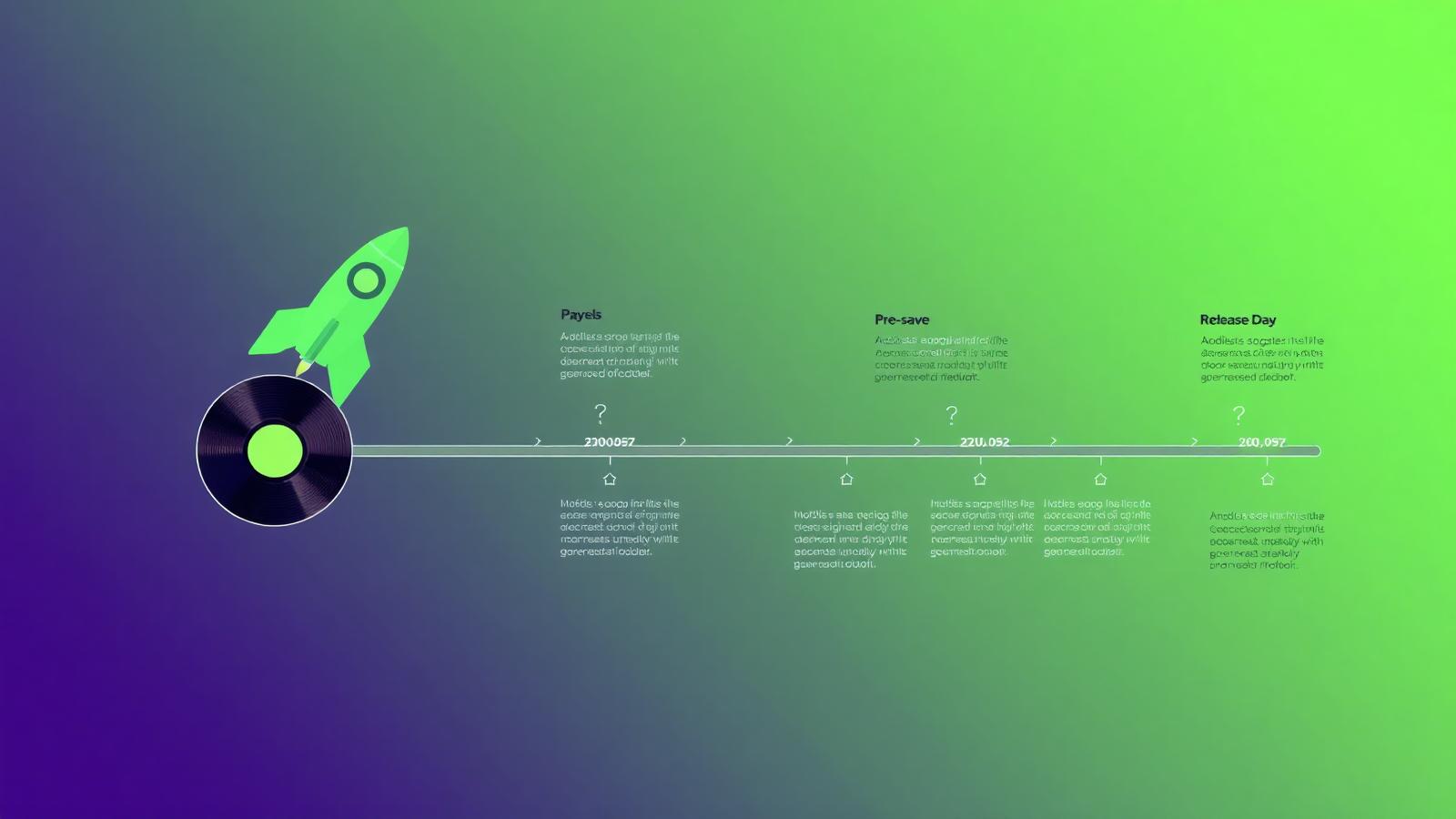
- Week -6: Finalise the master and all assets. Set the release date. Draft your pitch and bio.
- Week -4: Submit to the platform's editorial team. Build or clean your outreach contact list. Set up your pre-save / landing page.
- Week -3: Begin personalised outreach to DJs and curators with a private link. Start teasing on social.
- Week -2: Follow up (once) with contacts who haven't responded. Ramp up short-form clips.
- Week -1: Email your own fan list with a "out this Friday" note and pre-save link. Line up any premiere or first play.
- Release day: Email fans again ("it's live — one tap to save"). Post across every channel. Thank early supporters personally.
- Week +1 to +2: Send results-focused follow-ups to contacts, share plays and features as social proof, and pitch to new curators using that proof.
The release doesn't end on Friday. The two weeks after release — where you compound social proof — are where most of the earned reach actually happens. For a fuller version of this schedule, see our music release strategy plan, and to zoom out to the bigger picture, follow the 90-day music marketing plan.
Metrics that actually matter
Ignore vanity numbers. Track signals that predict real growth:
- Save rate — of people who hear the track, how many keep it?
- Playlist adds from real curators — not bot lists.
- Email open and reply rates — is your outreach landing?
- DJ plays and features — actual support from tastemakers.
- Repeat listeners — are people coming back?
If saves and replies are healthy but total numbers are low, you have a reach problem — do more outreach. If reach is high but saves are low, you have a music or targeting problem — fix that before spending more.
Common mistakes to avoid
- Promoting to everyone instead of the right someone. A hundred relevant contacts beat a mass blast to thousands.
- Buying streams or followers. It's the fastest route to suppression and lost trust.
- Going silent after release day. The post-release window is where momentum compounds.
- Skipping the owned audience. If you're not building an email list, you're rebuilding your reach from scratch every single release.
- Sending generic messages. "Check out my new track" is an instant delete. Relevance is everything.
- Judging a release in 48 hours. Give real campaigns weeks, not days.
For a deeper breakdown of the traps that quietly kill campaigns, read Music Promotion Mistakes Independent Artists Make. And to do all of the above faster, see how AI tools for music promotion can handle the repetitive work.
Putting it all together
Music promotion in 2026 isn't about doing more — it's about doing the right things in the right order. Get your music and assets ready. Build and protect an audience you own. Reach tastemakers personally. Support it all with consistent content, and only pour fuel on the fire once something is already burning.
Start with one release and one channel done properly — most likely direct outreach plus your email list. Master that, measure it, and expand from there. Do this for three releases in a row and you'll have something most artists never build: a repeatable system that gets your music heard every time.
When you're ready to run outreach at scale — reaching a vetted network of DJs and industry contacts, personalising every message, and tracking who actually engages — The Musical Road was built to make exactly that process fast and measurable. Either way, the framework above is yours. Go use it.
Frequently asked questions
How long before release should I start promoting my music?
Start roughly six weeks out. Finalise your master and assets by week -6, submit to editorial playlists and build your outreach list by week -4, begin personalised DJ and curator outreach around week -3, and email your own fans in the final week and on release day. The two weeks after release are where earned reach compounds, so keep going.
Should I pay for streams or playlist placements?
No. Bought streams and bot playlists inflate numbers, trigger fraud detection, and can get your music suppressed or removed. Focus on real saves, genuine playlist adds and tastemaker support instead — those are the signals platforms actually reward.
What is the single most underrated promotion channel?
Your owned audience — an email list of people who asked to hear from you. It converts far better than social posts, you control it completely, and it will still be working for you years from now regardless of which apps rise or fall.
How do I know if my promotion is working?
Track save rate, playlist adds from real curators, email open and reply rates, DJ plays and repeat listeners. If saves and replies are strong but totals are low, do more outreach. If reach is high but saves are low, fix the music or your targeting before spending more.
Founder of The Musical Road
Kamil Bobin is the founder of The Musical Road, a platform helping independent artists promote their music professionally to DJs, radio stations, curators and industry professionals. He writes about music promotion, email marketing, release strategies and practical growth tactics for independent musicians.