On this page
AI for Music Promotion: A Guide for Independent Artists
AI has gone from novelty to daily tool for independent artists faster than almost any technology before it. Used well, it removes the two things that hold most artists back from promoting consistently: not enough time, and not enough certainty about what to say. Used badly, it produces generic spam that recipients delete on sight. This guide shows you how to use AI to promote your music more effectively — and where the human touch is non-negotiable.
The goal isn't to hand your career to a machine. It's to let AI handle the slow, repetitive parts so you spend your energy on the things only you can do: making the music and building real relationships. Think of this as the modern layer on top of The Complete Guide to Music Promotion in 2026.
What AI is genuinely good at (and what it isn't)
Being clear-eyed here saves you from both hype and disappointment.
AI is great at:
- Drafting first versions fast — emails, bios, captions, descriptions.
- Overcoming the blank page and generating options to react to.
- Summarising, reformatting and repurposing content.
- Helping you plan, brainstorm and organise.
AI is not good at (on its own):
- Genuine relationships — a real connection with a DJ or fan.
- Authentic taste and originality — your unique perspective.
- Knowing the specific, real detail that makes outreach land.
- Being trusted — recipients can smell generic AI copy.
The winning formula is AI drafts, you direct and personalise. Speed from the machine, authenticity from you.
1. Writing promo emails faster (without sounding like a robot)
Outreach is where most artists lose momentum — writing dozens of personalised emails is exhausting, so they either send lazy copy-paste messages or give up. AI fixes the bottleneck without lowering quality, if you use it right.
- Generate a strong first draft based on your track and the recipient, then edit it into your voice.
- Always add one real, specific detail the AI can't know — a set the DJ played, a track they supported, a shared scene. That single human touch is what separates a reply from a delete.
- Keep it short and honest. AI tends to pad; trim it back to the tight structure that actually works, described in How to Write a Music Promo Email That Gets Opened.
This is exactly what the free DJ Promo Email Generator is built for: it produces a personalised, genre-aware promo draft in seconds so you're editing instead of staring at a blank screen. Generate, personalise, send.
2. Crafting bios, descriptions and press copy
Writing about yourself is hard. AI is a fantastic sparring partner for it:
- Draft your artist bio in short and long versions, then rewrite it to sound like you. (Put it straight into your EPK.)
- Write Spotify pitch descriptions, playlist submission blurbs and release notes.
- Generate multiple angles for the same track so you can pick what resonates.
Feed the AI real, specific details about your music and story — the more concrete input you give, the less generic the output. Then always do a final human pass so it reflects your actual voice.
3. Generating content ideas and captions
Consistency is the hardest part of content, and AI removes the "what do I even post?" friction:
- Brainstorm content ideas around a release — angles, hooks, series concepts.
- Draft caption variations you can refine and schedule.
- Repurpose one piece of content into many formats (a story into a caption, a caption into an email teaser).
- Plan a content calendar for a release cycle.
Use AI for the ideation and first drafts; keep the personality, humour and authenticity human. Fans follow you, not a content machine.
4. Planning and strategy
AI is an excellent thinking partner for the parts of promotion that require structure:
- Build a release timeline and adapt frameworks like the 6-week release strategy to your situation.
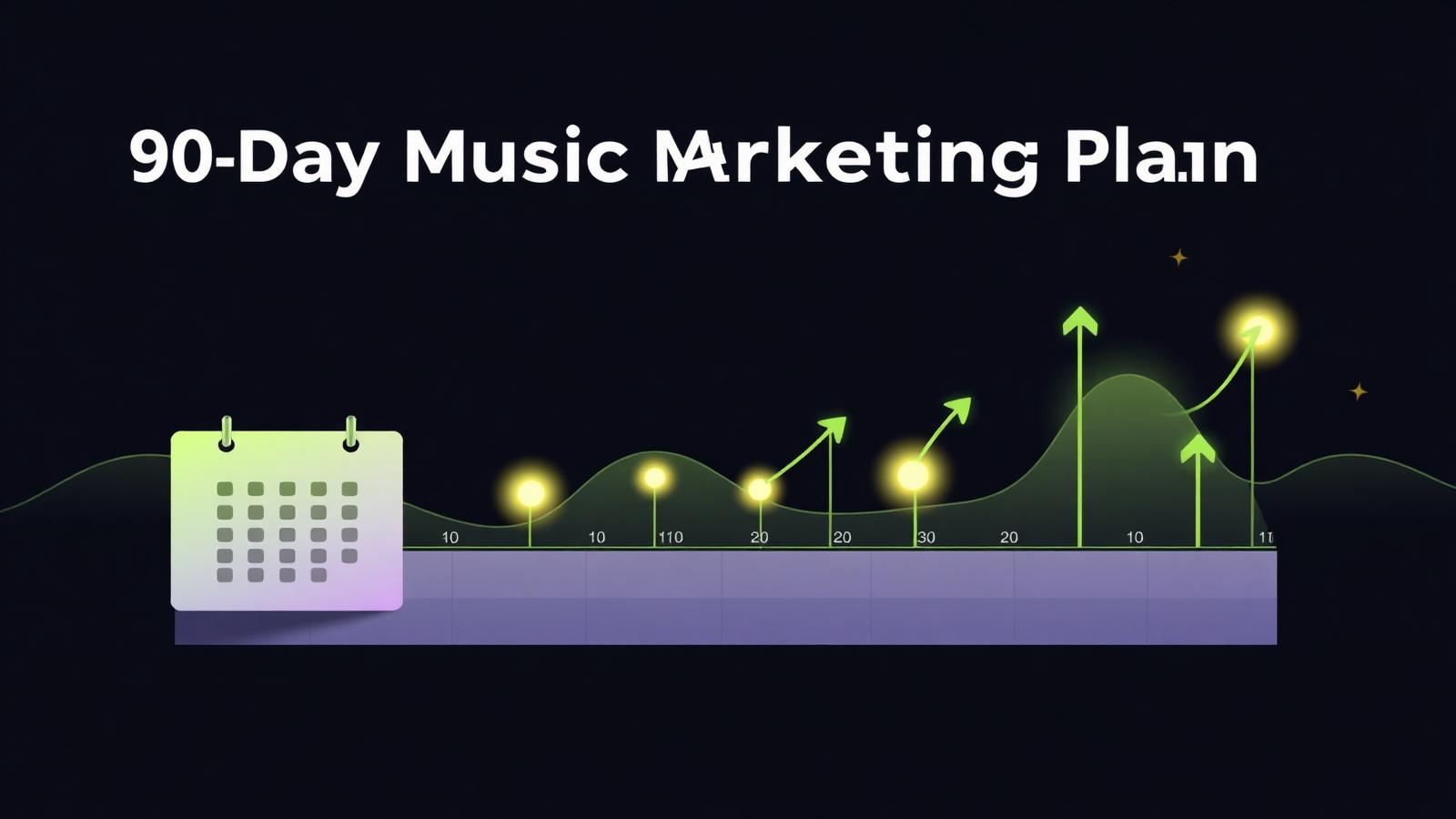
- Organise your 90-day marketing plan into weekly tasks.
- Draft outreach lists' criteria, brainstorm target scenes, and structure your campaigns.
- Ask it to pressure-test your plan — "what am I missing?" often surfaces real gaps.
It won't replace judgement, but it will help you organise and stress-test your thinking far faster than doing it alone.
5. Understanding your data
AI can help you make sense of the numbers you already have:
- Interpret your streaming and campaign stats — what's a save rate telling you, where are listeners coming from?
- Spot patterns across releases you might miss manually.
- Turn data into decisions — "given these numbers, what should I do next?"
The insight is only as good as the data you feed it, which is why tracking your promotion properly matters. A platform like The Musical Road captures opens, listens and downloads per contact — real data you (and AI) can actually act on. See the pricing for what's included.
The golden rules of using AI for music promotion
Follow these and AI becomes a genuine advantage instead of a liability.
| Rule | Why |
|---|---|
| AI drafts, you direct | Speed from AI, authenticity from you |
| Always add a real, specific detail | Generic outreach gets deleted |
| Never send raw AI output | Recipients can tell — it costs you trust |
| Feed it concrete input | Better input, less generic output |
| Keep relationships human | No AI can build real trust for you |
| Stay honest | Don't fake credentials or personalise falsely |
The mistakes to avoid
- Mass-blasting AI-generated messages. This is just faster spam. It's the classic error from Music Promotion Mistakes Independent Artists Make, turbocharged. AI should make your outreach more relevant, not more generic.
- Outsourcing your voice entirely. If everything you post sounds like a machine, fans disengage. Your personality is the product.
- Trusting AI blindly. It gets facts wrong. Check anything factual, especially in bios and pitches.
- Skipping personalisation because the draft "looks fine." The draft is the start, not the finish. The 30 seconds you spend adding a real detail is where the results come from.
A simple AI-assisted workflow
Here's how it fits together for a release:
- Plan the campaign with AI (timeline, tasks, angles).
- Draft your bio, descriptions and captions, then rewrite in your voice.
- Generate personalised outreach drafts with the DJ Promo Email Generator.
- Personalise each one with a real, specific detail.
- Send to a genuinely relevant list, then follow up once.
- Track engagement in one place and analyse with AI's help.
- Repeat, improving each cycle.
Notice AI touches every step but replaces none of the human ones — the relationships, the taste, the personalisation, the music.
Writing effective prompts as a musician
The quality of what AI gives you depends almost entirely on what you give it. Vague input produces vague, generic output — the kind that gets deleted. Specific input produces something you can actually use.
Compare these two prompts for a promo email:
- Weak: "Write a promo email for my new song."
- Strong: "Write a 90-word promo email to a melodic-techno DJ who plays late-night sets. My track is 122 BPM in A minor, dark and hypnotic, out next month. Mention it suits peak-time. Friendly, professional tone, one soft ask."
The second gives the AI genre, mood, tempo, timing, context and tone — so the draft arrives 80% of the way there. Feed AI the same details you'd want a human collaborator to have: who it's for, what makes the track distinctive, and the outcome you want.
Where AI saves the most time across a release
To see where AI actually earns its place, map it to a release cycle:
| Stage | AI helps with | You still own |
|---|---|---|
| Planning | Timeline, task lists, angles | The strategy and priorities |
| Assets | Bio, descriptions, captions | Your voice and story |
| Outreach | Personalised first drafts | The real detail + the relationship |
| Content | Ideas, variations, repurposing | Personality and authenticity |
| Analysis | Interpreting stats, spotting patterns | The decision on what to do next |
Notice AI never owns the last column — the judgement, the voice, the relationships. That's the line to hold.
Protecting your authenticity and originality
Fans and industry professionals increasingly recognise generic AI output, and it quietly erodes trust. Three habits keep you on the right side of the line:
- Run a final human pass on everything. Read it aloud. If it doesn't sound like you, rewrite until it does.
- Keep a personal swipe file of phrases, stories and details that are uniquely yours, and weave them in so no draft is purely machine-made.
- Never fabricate. Don't let AI invent credentials, placements or fake personalisation. It's easy to check and instantly fatal to your credibility.
Used this way, AI amplifies your originality instead of flattening it — it clears the busywork so your actual voice gets more airtime, not less.
The realistic future of AI for independent artists
AI tools will keep getting faster and more capable, but the fundamentals won't change: music is a human connection business. The artists who win with AI won't be the ones who automate the most — they'll be the ones who use automation to spend more time on the irreplaceable parts. Let AI handle the blank page and the repetition; you handle the taste, the relationships and the songs. That balance is durable no matter how the tools evolve.
The takeaway
AI is the best assistant an independent artist has ever had: it kills the blank page, speeds up the repetitive work, and helps you plan and analyse. But it's an assistant, not a replacement. Use it to draft faster and think clearer, then add the human detail, voice and relationships that no machine can fake. Do that and you'll promote more, and more consistently, without sounding like everyone else. Start with a personalised draft from the DJ Promo Email Generator, explore more guides on the blog, and start free on The Musical Road to run it all in one place.
Frequently asked questions
Can AI help with music promotion?
Yes, AI can streamline music promotion by drafting press releases, generating social media captions, and organizing outreach schedules, allowing artists to focus more on creative work.
Will AI-generated emails get marked as spam?
Generic AI copy is often ignored. To avoid spam filters and build real connections, always personalize AI drafts with specific details about the recipient and your music.
Founder of The Musical Road
Kamil Bobin is the founder of The Musical Road, a platform helping independent artists promote their music professionally to DJs, radio stations, curators and industry professionals. He writes about music promotion, email marketing, release strategies and practical growth tactics for independent musicians.