On this page
A great track with no release plan is a firework you light in an empty field. Nobody's there to see it. The artists who consistently grow aren't necessarily making better music than you — they're releasing it inside a structure that gives every song the best possible chance in its first, most important weeks.
This is that structure: a six-week release strategy you can run for every single you put out. It's the operating timeline behind The Complete Guide to Music Promotion in 2026, broken into a week-by-week plan you can actually execute.
Why six weeks?
Six weeks is the sweet spot. It's long enough to:
- Submit to Spotify editorial with room to spare (they want 7+ days; more is better).
- Run a pre-save campaign that builds real day-one momentum.
- Reach DJs, curators and radio while they still have time to add and test the track.
- Warm up your own audience so release day isn't a cold start.
And it's short enough to stay focused and repeatable. You don't need six months. You need six weeks used well.
The strategy in one view
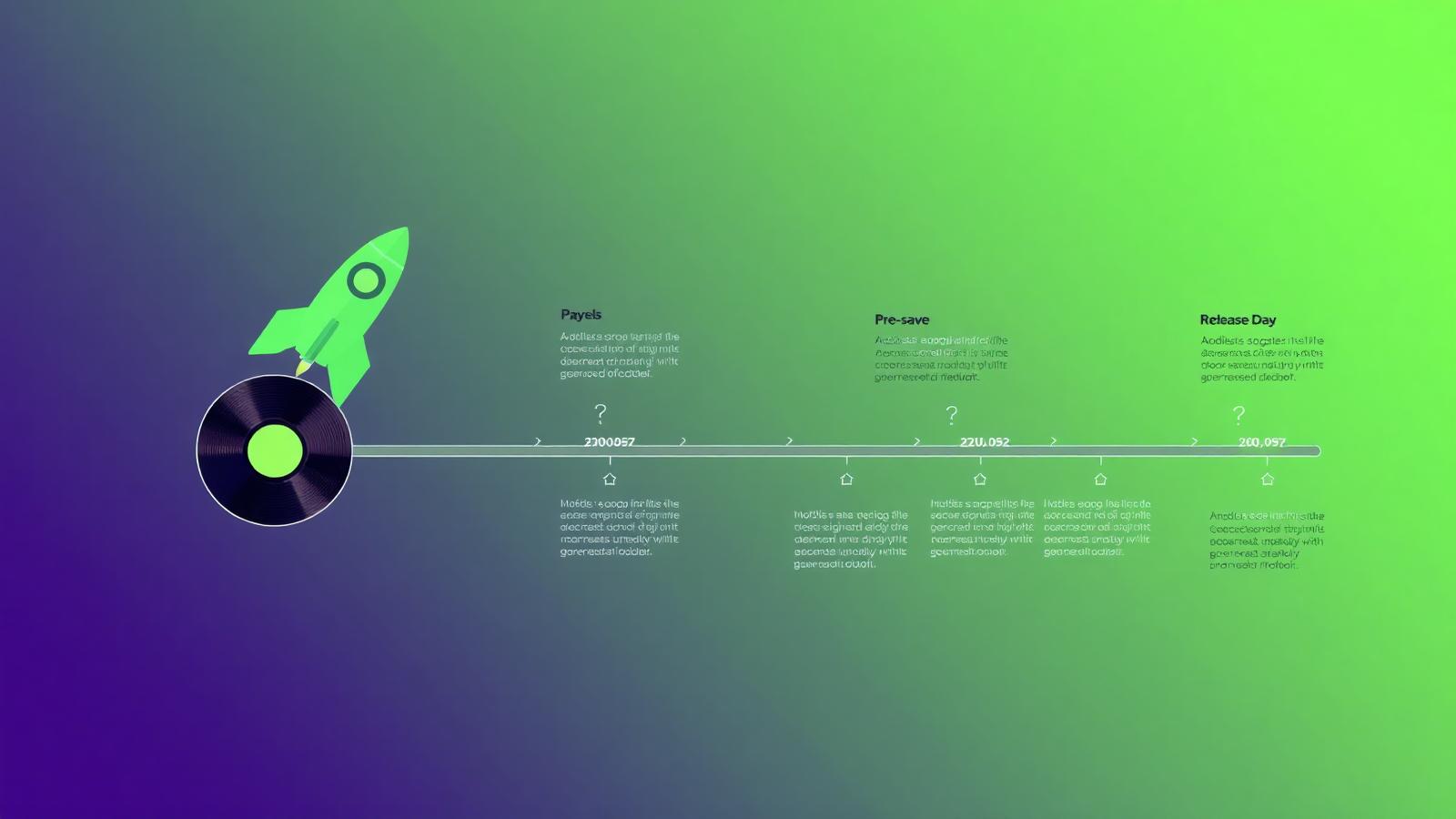
| Week | Focus |
|---|---|
| Week -6 | Finalise music and assets |
| Week -5 | Build lists and set up pre-save |
| Week -4 | Submit editorial, launch pre-save |
| Week -3 | DJ, curator and radio outreach |
| Week -2 | Warm up your own audience |
| Week -1 | Final push and release-day prep |
| Release week | Launch hard, engage, follow up |
| Weeks +1 to +4 | Sustain, convert, analyse |
Now the detail.
Week -6: Finalise the music and assets
Nothing else works if the foundation isn't ready. This week is about locking everything so the rest of the plan runs smoothly.
- Final master. Broadcast- and streaming-ready. Have a clean/radio edit if needed.
- Cover art. Eye-catching at thumbnail size, consistent with your brand.
- Deliver to your distributor. Set the release date far enough out to hit editorial deadlines.
- Grab your ISRC and metadata. Correct credits, so plays and royalties attribute to you.
- Prepare a Spotify Canvas and a short visualiser or teaser clips.
- Write a one-paragraph press bio for outreach and your EPK — see How to Build an EPK.
If the track's opening doesn't grab attention in the first 30 seconds, fix it now. Skip rate directly shapes your streaming reach.
Week -5: Build your lists and set up pre-save
With assets locked, prepare the machinery of the campaign.
- Build your outreach lists: DJs, curators, radio shows and media that genuinely fit your sound. Relevance over volume, always.
- Set up your pre-save campaign so it's ready to launch next week. Full guide: Spotify Pre-Save Campaigns.
- Draft your outreach templates so you're editing, not writing from scratch. The free DJ Promo Email Generator gives you a strong personalised starting point, and our guide to AI tools for music promotion covers the rest of the repetitive work you can automate.
- Plan your content calendar for the next five weeks of teasers and posts.
Building relevant lists by hand is the slow part; a vetted, filterable network like The Musical Road removes most of the grind.
Week -4: Submit to editorial and launch pre-save
This is a pivotal week — the moment your campaign goes from preparation to motion.
- Submit to Spotify editorial via Spotify for Artists (this also guarantees Release Radar placement for your followers). Method in Spotify Playlist Pitching.
- Launch your pre-save campaign and start driving sign-ups.
- Begin teasing the release to your own audience with your first clips.
- Announce the release date across your channels.
Pre-saves collected now become saves on release day — the early signal that kick-starts the algorithm.
Week -3: Outreach to DJs, curators and radio
Now you reach the people who can put your music in front of new audiences.
- Send personalised outreach with private preview links to DJs, playlist curators and radio shows.
- Lead with relevance — why this track fits this person's audience.
- Send mid-week mornings, when working DJs and hosts read email rather than gig.
- Keep each pitch short and human — the exact structure is in How to Write a Music Promo Email That Gets Opened.
Reaching out three weeks ahead gives DJs time to add and road-test the track before it's public — exactly what makes DJ promotion work (see the DJ guide).
Week -2: Warm up your own audience
Your owned audience is your most reliable release-day engine. This week, prime it.
- Email your list with a heads-up and the pre-save link.
- Increase your teaser cadence — snippets, behind-the-scenes, the story of the track.
- Send one polite follow-up to outreach contacts who haven't replied.
- Confirm the essentials — links live, Canvas uploaded, pre-save working.
Fans who feel involved before release show up on release day. That's the whole point.
Week -1: Final push and release-day prep
The last stretch before launch. Tie up loose ends and stack the deck.
- Final reminder email to your list with the exact release date.
- Schedule release-day content so you're engaging, not scrambling.
- Prepare your release-day email to send the moment the track is live.
- Line up your asks — you'll be requesting saves and adds, not just listens.
By now, ideally you have pre-saves banked, curators primed, DJs holding the track, and an audience that's expecting it.
Release week: launch hard
The first 24–48 hours carry the most weight. Go all in.
- Email your list on release day. Highest-converting channel, full stop.
- Post everywhere with one clear call to action and your Canvas clip.
- Ask for saves and adds explicitly.
- Follow up with interested DJs, curators and radio — once.
- Engage relentlessly — reply to every comment, thank every supporter by name.
- Monitor Spotify for Artists for early save rate and traffic sources.
Concentrate your energy in the opening days rather than dribbling it out over two weeks.
Weeks +1 to +4: sustain and convert
The release isn't over when it's out. This is where a one-off spike becomes lasting growth.
- Chase secondary placements — independent playlists, blog and radio adds.
- Watch for algorithmic pickup in Discover Weekly and Radio.
- Repurpose top content into new clips.
- Move new listeners to your email list — turn borrowed reach into owned reach.
- Thank and tag supporters publicly to attract the next wave.
- Analyse everything: save rate, sources, best-performing channels.
Then feed those learnings straight into your next six-week cycle.
What to prepare before week -6 even starts
The six-week plan assumes your track is finished and strong. If it isn't, the countdown hasn't really begun. Before you set a release date, make sure:
- The song itself is competitive — the mix is clean, the master is loud enough, and the first 30 seconds grab attention. Promotion amplifies the track; it can't rescue a weak one.
- You've gathered honest feedback from people who'll tell you the truth, not just encouragement.
- You know your positioning — genre, mood, and who this track is for — because every pitch and description depends on it.
Get these right first, and the six-week machine has something worth pushing.
A release-day run sheet
Release day is chaotic unless you've scripted it. Prepare this simple run sheet in advance so you're executing, not improvising:
| Time | Action |
|---|---|
| Track goes live | Send your release-day email to your list |
| First hour | Post across all platforms with one clear ask (save/add) |
| Morning | Personally thank pre-savers and early supporters |
| Midday | Follow up with interested DJs, curators and radio (once) |
| Afternoon | Engage every comment, share and repost |
| Evening | Check Spotify for Artists — early save rate and sources |
Having this written down turns the most important day of your campaign from stressful guesswork into a calm checklist.
Common release strategy mistakes
Even with a plan, a few errors quietly undermine releases. Avoid these:
- Compressing the timeline. Skipping the pre-release phase to release faster forfeits editorial submission, pre-saves and outreach — the exact levers that create momentum.
- Going quiet after release day. The first four weeks matter; stopping on day one wastes the algorithmic window you worked to open.
- Releasing too often to promote properly. If you can't run at least a basic version of this plan per release, you're releasing faster than you can build momentum.
- Not measuring. Without tracking what drove saves, every release starts from zero instead of building on the last.
Scaling the plan as you grow
Early on, run one release at a time with the full six weeks. As you get more prolific, overlap cycles — one track compounding while the next is in pre-release — and lean on your growing email list and warm industry relationships to make each launch land harder than the last. The framework doesn't change; what changes is the size of the audience and the strength of the relationships you're launching into. That's how a repeatable release strategy turns single tracks into a career.
Make it repeatable
The magic of a release strategy isn't any single campaign — it's running the same proven system every time, improving it with each cycle. That requires tracking: who you pitched, who opened, who supported you, and what actually drove saves. Do that in one place and every release gets smarter than the last. The Musical Road is built for exactly this; see the pricing to find your plan, and fold this timeline into your broader 90-day marketing plan.
The takeaway
Great releases aren't lucky — they're planned. Six weeks of deliberate work turns "I dropped a track" into "I ran a campaign," and campaigns are what compound into careers. Lock your assets at week -6, build momentum through the pre-release phase, launch hard, and sustain past release day. Then do it again, a little better, every time. When you're ready to run the whole thing in one place, start free on The Musical Road.
Frequently asked questions
How far in advance should I plan a music release?
About six weeks. That's long enough to submit to Spotify editorial with room to spare, run a pre-save campaign, reach DJs and curators while they can still add the track, and warm up your own audience — but short enough to stay focused and repeatable.
What should I do first when planning a release?
Finalise the music and assets at week -6: a broadcast-ready master (and clean edit if needed), cover art, delivery to your distributor, correct metadata and ISRC, a Spotify Canvas, and a one-paragraph press bio. Nothing else in the plan works without this foundation.
When should I submit to Spotify editorial playlists?
Around week -4, at least 7 days before release, via Spotify for Artists. Submitting also guarantees the track lands in your followers' Release Radar on release day, so it's never wasted even if you don't land an editorial add.
What should I do after a release comes out?
For the first four weeks, chase secondary independent playlists, watch for algorithmic pickup, repurpose your best content, move new listeners to your email list, thank supporters publicly, and analyse what drove saves — then feed those learnings into your next cycle.
Founder of The Musical Road
Kamil Bobin is the founder of The Musical Road, a platform helping independent artists promote their music professionally to DJs, radio stations, curators and industry professionals. He writes about music promotion, email marketing, release strategies and practical growth tactics for independent musicians.